
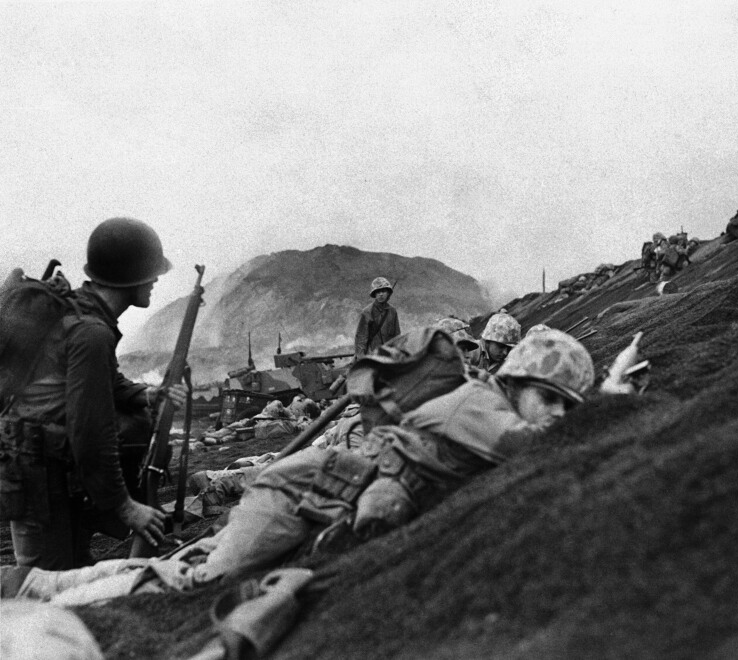
D-Day on Iwo Jima
Iwo Jima is the iconic Pacific Theater battle of the Second World War. The silhouettes of US soldiers raising the flag on Mount Suribachi is one of the most famous war photographs of all time. The hell the Marines faced on the beaches, and what it took to get to the top of Suribachi, remains largely overlooked.
In 1944, after the American capture of the Marianas Islands, Iwo Jima became an area of growing interest to both the American and Japanese high commands.1 The US Army Air Force planned to use the Marianas as an air base from which to send the new B-29 bombers to strike the Japanese mainland. Between the Marianas and Japan stood the tiny strip of volcanic islands known as the Bonins.
Of the Bonin Islands Iwo Jima stood out as the most important. A desolate volcanic island of only eight square miles, Iwo Jima was often described as resembling a pork-chop from overhead. Iwo’s importance was far greater than its size alone would suggest. Japanese fighters scrambled from there to intercept the B-29s in the early raids from the Marianas. Laying directly in between the Marianas and Japan, 625 miles north of Saipan and 660 miles South of Tokyo, fighters could attack both incoming and returning B-29’s.2 The Zero fighters from Iwo Jima took a large toll on the bombing raids; the US intended to silence them.
Thanks for reading History of the Pacific Theater of WWII ! Subscribe for free to receive new posts and support my work.Subscribe
Beyond the fighters, Iwo Jima housed a radar station that provided two hours of warning to the Japanese mainland that a raid was coming.3 Those two factors in combination made the early B-29 raids costly in lives and ineffective. Major-General Curtis LeMay, in command of the B-29 bombers, said that “without Iwo Jima, I couldn’t bomb Japan effectively.”4
The Americans intended to capture the island and use it as an emergency airstrip for B-29s to land on. The airstrip could also accommodate P-51 fighters, which had a shorter range than the B-29 and could not make the flight from the Marianas. From an airstrip on Iwo, the P-51’s could escort the B-29’s on their bombing runs of the Japanese homeland.
On October 3, 1944, the American Joint Chiefs authorized the invasion of Iwo Jima, slated for early 1945.5 The Japanese understood an invasion of the island was coming, and were prepared to defend to the last man. No foreigner had ever before stepped foot on the island, but the Marines were coming.6
Tadamichi Kuribayashi and the Creation of a Killing Machine
On 19 June 1944 Lieutenant-General Tadamichi Kuribayashi landed on Iwo Jima to command its defense.7 Kuribayashi was amongst the elite of Japanese military commanders. He had eight months to plan. Before going to Iwo Jima, Kuribayashi was told by Hideki Tojo, Prime Minister of Japan and a military leader, “do something similar to what was done on Attu.”8 This amounted to a suicide order, Kuribayashi showed up prepared to die on the island. In a letter written home to his wife he told her to expect his imminent death:
“… The enemy may land on this island soon. Once they do, we must follow the fate of those on Attu and Saipan. Our officers and men know about “Death” very well. I am sorry to end my life here, fighting the United States of America but I want to defend this island as long as possible to delay the enemy air raids on Tokyo.
Ah! You have worked well for a long time as my wife and mother of my three children. Your life will become harder and more precarious. Watch out for your health and live long. The future of our children will not be easy either. Please take care of them after my death.”9
Kuribayashi meticulously planned the defense of the island. Shortly after his arrival he took Major Yoshitaka Horie to the beaches he predicted the Americans would land on. Throughout the day Kuribayashi would lay on the ground and point his cane at Horie, “shooting” him from different positions. 10 This attention to detail was a staple of Kuribayashi’s leadership, and certainly played a massive role in the battle to come.
On Iwo Jima, Kuribayahsi was determined to not repeat the mistakes made earlier in the war by the Japanese defense on other islands. Instead of fighting bitterly on the landing beaches, they would let the Americans land and bunch up before hurling large amounts of artillery and mortar shells at them. Opposed to fruitlessly launching a Banzai charge once the Americans had secured a beachhead, they would defend in depth and make the Marines fight for every inch of the island. General Holland Smith, who led the Marines on Iwo Jima, said at one point during the battle to come, “I don’t know who he is, but the Japanese General running this show is one smart bastard.”11
The Japanese were creating a horror house for the Marines to invade. Once the Marines started to hit the beaches the trap would be set. Kuribayashi instructed his men:
“We cannot allow ourselves to be captured by the enemy. If our positions are overrun, we will take bombs and grenades and throw ourselves under the tanks to destroy them. We will infiltrate the enemy’s lines to exterminate him. No man must die until he has killed at least ten Americans. We will harass the enemy with guerrilla actions until the last of us has perished. Long live the Emperor!”12
Pre Battle
In the months leading up to the invasion, B-24 and B-29 bombers attacked the island constantly. During the final countdown to D-Day they bombed the island for 74 straight days.13 It set the record for the heaviest and longest sustained bombardment of the Pacific War.14 Task Forces of Naval ships also swung by and shelled the island. The Americans intended to “soften up” defenses on Iwo through months of consistent bombing. They understood a sizable garrison was positioned there, but through superior firepower American commanders believed they could diminish the Japanese strength.
U.S. Intelligence was amazed by what appeared as the complete disappearance of the Japanese garrison on the island. Through photographic intelligence over time they had watched as the Japanese abandoned aboveground buildings and went underground. Captain Thomas Fields remarked, “The Japanese weren’t on Iwo Jima. They were in Iwo Jima.”15
Opinions on how long it would take to conquer Iwo Jima differed, some believed Iwo Jima would take three days to conquer, others five days, a week, or maybe even ten days.16 Not all American commanders agreed with these assessments, though. In the weeks leading up to D-Day Admiral Richmond Kelly Turner Stated, “Iwo Jima is as well defended as any other fixed position in the world today.”17 General Holland Smith, who would be leading the Marine Expeditionary force, proclaimed, “It will be the toughest place we have had to take. I don’t know what anybody wants it for, but I’ll take it.”18 Smith also suggested, “This is going to be a rough one … we could suffer as many as 15,000 casualties here.”19 Holland Smith would be proven wrong, the Marines would suffer more.
On Feb. 16, the Americans began their official pre-landing bombardment. The Americans combed the island with Naval vessels covering different sections in a grid. The ships knew which targets needed shelling in their section of the grid, and how many shells to shoot.20 It was largely to no avail. Kuribayashi had dug in his defenses; a labyrinth of underground fortifications protected his troops remarkably well.
Eventually, some 1,500 subterranean bunkers were connected by 16 miles of tunnels on Iwo Jima. One bunker, a brigade headquarters, was 75 feet deep, could hold 2,000 troops, and had a dozen entrances.21 This underground city contained everything necessary to run a modern battle. Iwo Jima was the most heavily fortified island in all of the Pacific War.22
D-Day 3:00 a.m. — 9:00 a.m.
On the morning of Feb. 19, the largest armada to date of the Pacific War surrounded the island of Iwo Jima.23 It consisted of 485 ships.24 These ships contained all the necessary supplies to support the Marines landing and taking of Iwo Jima — some 98,000 tons of supplies.25 At 3 a.m. Marines of the 4th and 5th Division were awakened.26 At 3:30, they were served a breakfast of steak and eggs, the meal served to Marines prior to every D-Day landing of the war. There were 75,000 troops in the landing force, almost entirely Marines; in total there were 110,000 troops present.27 They were tasked with taking the island against a 22,000 man Japanese garrison.28 There were elements of the Third, Fourth, and Fifth Marine Divisions present, with the Third Division standing in reserve.
At 6:30, the troop transports that would take the Marines ashore began loading up and getting into position, the mood was tense as the Marines boarded their landing vessels:
“I was petrified when we got into those amtracs, … I was new to battle but I could sense even the veterans were scared.” 29
Vernon Parish – US Marine Corpsman
Shortly thereafter the heaviest naval bombardment in world history began. 30 At one point, eight thousand shells were launched onto the island in just thirty minutes.31 Marines were in awe of the barrage; many were veterans of earlier campaigns and were aware this was larger than any prior invasion. Robert Sherrod, a war correspondent who had witnessed multiple landings throughout the war, called it “more terrifying than any other spectacle I had ever seen.”32 Ronald Thomas, a Marine of the Firth Marine Division said of the bombardment: “It didn’t seem possible that anything could be alive.”33
Despite this massive bombardment, Iwo’s defenses remained remarkably intact. Fewer than 200 of 915 major installations were knocked out, and thousands of smaller positions still stood in the Marines’ way. 34
The Line of Departure (LD), the Marine landing formation, was established at 7:30. It was comprised of four assault regiments of troops from the Fourth (23rd and 25th Regiment) and Fifth (27th and 28th Regiment) Marine Divisions.35 At 8:30 the Central Control vessel released the ships.36
9:00 a.m. — 10:00 a.m.
A few minutes before 9:00, the barrage stopped, and at almost 9:00 on the dot, the Marines of the Fourth and Fifth Marine Divisions began landing on the beaches. Small-arms fire rattled, but overall the fire against the Marines was surprisingly light. The biggest difficulty was the fine black volcanic ash, which appeared to outsiders as sand, which was difficult to maneuver on. This was particularly a problem right off the beach where the “sand” rose 15 feet to a terrace.
The first wave consisted of tracked landing vehicles, their job was to push inland and establish the beachhead before infantry landed in the second wave. The large, lumbering vehicles found the terrain remarkably difficult to navigate.
By 9:12, four waves had already been put ashore.37 The Japanese defensive fire was still much lighter than anticipated. The Marines did not know what to think. One Marine was suspicious of the Japanese lack of activity. “There’s something screwy here,” said Corporal Leonce Oliver, a veteran of the Tarawa campaign.38 Some allowed themselves to believe that the pre-landing bombardment had seriously hindered the Japanese ability to respond:
“When the landing gate dropped I just walked onto the beach. I was confident. Everyone was milling around. I thought this would be a cinch.”39
Donald Howell – US Marine Corps
Two miles offshore on the Eldorado, General Holland Smith would be tracking the action all morning. At 9:11 Colonel Thomas Wornham, of the Fifth Marine Division 27th Regiment, radio’d the Eldorado from Red Beach:
“Landings on schedule. Casualties unexpectedly light. Proceeding toward airstrip against light resistance.” 40
At 9:17 Colonel John Lanigan, of the Fourth Marine Division 25th Regiment, sent a similar update to the Eldorado from Blue Beach:
“Bogging down in heavy sand and steep terraces, but condition generally favorable. Moving forward against airstrip under moderate fire.”41
At 9:30, the first tanks came ashore and ran into the same issues that earlier tracked vehicles had found: being bogged down in the volcanic ash.42
10:00 a.m. — 12:00 p.m.
Shortly after 10:00 the sound of bugles was heard throughout the island. The Japanese were playing a famous military tune, the notes of the song symbolized, “come out, come out, kill them all.”43 Ensign Ōmagari heard the bugles, and told the 36 men under his command, “Iwo Jima will be our tomb.”44
What the tune represented was every Americans worst fear. The Japanese had not been silenced from the pre-landing barrage, nor by the 74 days of bombing and shelling. Shortly after 10:00, Kuribayashi finally allowed his big guns to open up. Massive ‘spigot mortars’, artillery guns, anti-aircraft weapons lowered and registered onto the beach, all opened up at around the same time. Every inch of the landing beaches was covered with fire. The fighting on Iwo Jima was savage from this point on.
Shortly after Kuribayashi allowed his guns to fire, seven landing craft took a direct hit in five minutes.45
Many of the Marines had been involved in other island invasions, but Iwo was unlike anything they had seen before. Mike Vinich of the 5th Marines landing in a later wave had a harrowing experience from the moment the ramp on his landing vehicle lowered:
“I can’t hardly describe it to you … the misery and the difference between this and all of the other island fighting I’d experienced. Coming to Iwo was a different kind of fight. … The ramp went down, and honest to God the bullets came in. Many of the men were machine-gunned to death as they were exiting. I was pulling bodies of my men aside as I tried to make my way out. Blood was everywhere. It was very similar to the opening scene in Saving Private Ryan, but I think the fire was more concentrated on Iwo. … I was on a bit of a knoll when a machine gun cut loose and got me in both legs. I fell down and broke my femur against this rock. … When I rolled down there, my BAR man was shot through the chest and was just gurgling. I couldn’t help him at all. His eyes were turned back in his head, and he was just gurgling. On the other side of me was my other BAR man, and he was hit through the chest. There were wounded and dying men all around –some hit in the chest, some in the neck. What they said in their dying breaths has haunted me all my life. They said two things: “Oh, God” and “Oh, Mom.” It was so sad.” 46
Another Marine, Thomas Lyons, from the 5th Marine Division, had a traumatic experience on the beaches of Iwo Jima:
“We got off the beach. As we were moving toward the runway, [one of the men] got completely emasculated. A shell exploded right in front of him, right under his feet. He was begging people to shoot him. His intestines were hanging out. He had small splinters all over. He begged people to shoot him. The chaplain told him he could make it, and he was hauling him back to the back, but he didn’t want to be saved and died on the beach. He had so many cuts they didn’t have enough bandages to cover them all. He was a very close friend of mine.”47
At 10:15, Marine Corpsman Danny Thomas landed close behind buddy Chick Harris. The heart-wrenching story is recounted in James Bradley’s Flags of Our Fathers:
““I was charging ahead and saw Chick on the beach, facing out to sea, his back to the battle,” Thomas recalled. His buddy was in a strange posture: His head and torso were erect, as though he’d let himself be buried in the sand from the waist down in some bizarre prank. As Thomas rushed past him, he yelled a greeting and saw Chick’s eyes move, acknowledging him. Then Thomas glimpsed something else that made him fall to his knees in the sand, vomiting. The “something else” was blood and entrails. “I vomited my toenails out,” Thomas remembered. “I realized that Chick had been cut in two. The lower half of his body was gone. He was the first person I ever saw dead.””48
Bradley finishes the account with this:
“‘Buttermilk Chick’ was fifteen. He had lied about his age to get into the Marines.”49
In another account, Marine Guy Castorini, a rookie in battle, recalled his experience on the beach following veterans like a Marine named Lundsford:
“We had no idea if this was a bad battle or not. One of the guys yelled, ‘Hey, Lundsford, is this a bad battle?’ Lundsford shouted back, ‘It’s a fucking slaughter.’ Maybe two minutes later — Whoom! — we got hit with a mortar. I ducked and something dropped on my back and rolled off. It felt like a coconut or something. I looked down and saw that it was Lundsford’s head. Those were his last words: ‘A fucking slaughter.’”50
By 10:30, the situation on the beaches was a nightmare. By this time, 90 minutes into the battle, the Marines had landed eight battalions, including two tank battalions and pieces of two artillery battalions.51 Associated Press reporter Joe Rosenthal, who landed with elements of the Fourth Division, reported that “not getting hit was like running through rain and not getting wet.”52 Another Marine remembered this scene:
“I was watching an amtrac to the side of us as we went in. … Then there was this enormous blast and it disappeared. I looked for wreckage and survivors, but nothing. I couldn’t believe it. Everything just vaporized.”53
Robert Leader — US Marine Corps 28th Regiment/Fifth Division
At 10:36 Colonel Lanigan of the 25th Regiment again sent a radio message to General Smith on the Eldorado, this time with an immensely different tone than the earlier messages:
“Catching all hell from the quarry. Heavy mortar and machine gun fire. Troops inland two hundred yards but pinned down.”54
Colonel Wornham of the 27th Regiment also radio’d the Eldorado again at 10:42. His message also was much more urgent than earlier:
“All units pinned down by artillery and mortars. Casualties heavy. Need tank support fast to move anywhere.” 55
At 10:46, Colonel Liversedge of the 28th Marines, attempting to isolate Mt Suribachi, sent a radio message to Eldorado under dire circumstances:
“Nearly across the neck [of the island] but taking heavy fire and forward movement stopped. Machine gun and artillery fire heaviest ever seen.” 56
Another Marine, Major John W. Antonelli stated that around 10:45, “crap hit the fan in copious quantities.”57 The artillery fire further intensified at 11:00.58 By 11:30 the Marines were making close to no forward movement.59 Unusually, the later waves of Marines were taking heavier casualties than the early ones.60 Yet the waves kept coming, and the Marines had no choice but to move forward:
“More and more boats kept landing with more guys coming onto the beach, … You just had to push the guy in front of you. It was like pushing him to his death.”61
Guy Castorini — US Marine Corps
The guns being used were often concealed immaculately. Corporal Glen Buzzard said, “Most of the guns were in caves, and they slide right up to the opening, fire, and then slide back. They’d put camouflage over them, brush, netting, whatever they had.”62
Throughout the day, and the battle to come, Marines were frustrated with the hidden subterranean complex the Japanese fought from:
“The thing that bothered me was you couldn’t get your licks in. There was no visible enemy to shoot at.”63
Sergeant Major Lyndolph Ward — US Marine Corps
12:00 p.m. — 5:00 p.m.
At noon, General Smith, onboard the Eldorado, noted through binoculars that the beaches looked like, “a row of frame houses in a tornado.”64 The conditions of the landing beaches was to be a big problem throughout the day. As landing vessels came in, many were hit by Japanese artillery, and a logjam of sorts began to pile up. The situation was so bad that some tracked vehicles had to drive over the bodies of slain Marines out of sheer necessity.65 Marine Corpsmen Roy Steinfort remembered his approach to the beach:
“Coming in, I could see guys lying on the beach, … I thought, great! They’ll cover our landing. But when we drew closer I saw they were all dead.”66
John Lyttle, a squad leader in H Company of the 28th Marine Regiment remembered this experience riding into the landing beaches:
“The Lieutenant and I had the best view of everything. We were within two hundred yards of the beach when I looked to my right and saw a weasel, a small amphibious tractor loaded with ammunition. … I was looking at the driver and gave him a thumb’s up. He smiled and then took a direct hit and disappeared. I looked at the Lieutenant, he leaned over and threw up, and then I followed suit. This always haunted me because I’m sure that I was the last thing that fellow ever looked at on earth.”67
By 1:00 p.m. Admiral Turner had to close the beaches until the debris could be cleared.68 It took two hours before boats were headed back to the beaches again. This was around the time of the hottest gunfire of the day.
Marine John Gramling was in an amtrac that circled in the water for hours due to closed landing beaches, he recalled his landing experience:
“We couldn’t get in because of the congestion, … When we hit the beach there were stacks of bodies.”69
By early in the afternoon, Captain Masao Hayauchi’s 12th Independent Anti-tank Battalion had destroyed several American Sherman tanks.70 By this time the unit had ran out of ammo. Their response was to charge the tanks, Hayauchi clutching a charge and running up against the tank before detonating, destroying the tank and himself.71
Combat Team 28 had one of the toughest jobs on D-Day. It had to cut across the island and isolate Mt. Suribachi. By 11:00 three squads had cut across the island to the far shoreline, but in the process found themselves cut off from the rest of the Marines.72 It would take several hours of hard fighting to get them back in contact with their regiment. Much of the 28th found itself disconnected and pinned down throughout the day as it fought its way across the island.
Sometime around 2:30, the only General to land on D-Day, Dutch Hermie, landed and set up the Fifth Division’s command post.73
By 4:00, the entirety of the 133rd Seabees were ashore — all 1,032 of them.74 Unique to the Iwo Jima campaign was an attempted landing of the Naval Engineer, “Seabees,” right alongside the landing force — it would not be tried again. On Iwo the Seabees suffered their worst casualties of the war.75
Certain companies and Battalions non-commissioned officers were almost completely wiped out throughout the day, leaving many companies leaderless heading into the first night on Iwo. “K” Company of the second Battalion, 24th Marine Regiment, had every single one of its officers either killed or wounded by 4:30.76
5:00 p.m. — 11:59 p.m.
At 5.00 p.m. a sickened Keith Wheeler from the Chicago Times told Robert Sherrod of Life magazine,
“I wouldn’t go in there if I were you. There’s more hell in there than I’ve seen in the rest of the war put together. The noise was unbearable.” 77
Sherrod did go in though, and in one account he talked about a Marine who cracked from the crashing artillery:
“As the shells burst, as they crashed and shrieked … one of the wounded rose from his stretcher. He rose slowly, bending at the waist. His head was bare and his arms were straight and rigid at his side … He sat mouth open … and screamed. “Oh my God! My God … Good God Almighty! The corporal sobbed into the dirt.”78
Another Marine remembered the noise, “It was so loud it was almost quiet.”
Late in the evening a Marine named Harlon was leading a crawling line of soldiers through heavy fire. Directly behind him was a Marine named Bill Ranous, Bill suddenly bumped into Harlon and recalled:
“We all looked to see what had stopped Harlon, … He was staring at two legs attached to hips with no upper torso. He was just transfixed, staring silently.”79
Another Marine in the line William Wayne had a different reaction than his fellow soldiers to the legs:
“I was in survival mode, … and seeing those legs didnt bother me at the time. But to Harlon they were a part of a person. He turned to me after a little while and said, softly, ‘why don’t we bury him?’” 80
The beach became continuously more clogged with bodies as the evening wore on. Every Marine coming back to the beachhead for more supplies brought a dead or wounded man with him.81 The sounds of the dying pierced the evening air, an untold number of men died there on the beach, lying on stretchers waiting to get off the island. One Marine corespondent said of the beachhead:
“At Tarawa, Saipan and Tinian, I saw Marines killed and wounded in a shocking manner, but nothing like the ghastliness that hung over the Iwo beachhead.” 82
The sunset on D-Day came at 6:45.83 The Marines held a tenuous foothold on the island and dug in to prepare for the nights counterattack. The famous banzai charge would not come on this night though. Part of Kuribayashi’s strategy in the defense of Iwo was to not charge the Marines line of defenses on the first night — or any night. This had been a staple of all island battles to this point, but Kuribayashi maintained a discipline not to repeat these mistakes.
Nightfall did not stop the Japanese artillery. Fire continued throughout the night wreaking havoc on the Americans attempt to organize. At 11:00 fire was so heavy that two of the landing beaches were ordered closed.84 Marine Danny Thomas, lying in his foxhole thought of the nights fire, “It seemed like you could stick a cigarette up and light it.”85
Infiltration by the Japanese was attempted during the night. At 11:15 a barge tried to flank the 28th Regiments line.86 The Marines mowed down the attackers. Individual and small groups of Japanese soldiers also tried to penetrate the Marine lines. Jumping in foxholes with edged weapons at night was a staple of how the Japanese fought. These infiltration attempts and artillery continued into the morning light and meant little sleep for the Marines.
At 4:00 A.M. an ammunition supply was hit, causing utter chaos in the surrounding sector.87 It was believed fire was concentrated on specific positions behind the Marine lines by Japanese infiltrators that would radio targets back to the guns.
“The first night on Iwo Jima can only be described as a nightmare in hell, … About the beach in the morning lay the dead … They died with the greatest possible violence. Nowhere in the Pacific have I seen such badly mangled bodies. Many were cut squarely in half. Legs and arms lay 50 feet away from any body. … All through the bitter night, … the Japs rained heavy mortars and rockets and artillery on the entire area between the beach and the airfield. Twice they hit the casualty stations on the beach. Many men who had been only wounded were killed.”88
Robert Sherrod
Closing Thoughts — The Battle Thereafter
At the end of the day, the Marines had suffered 2,420 casualties, more than 500 killed.89 Throughout the day, they had landed 40,000 Marines, the attackers held about 10 percent of the island — far less than the plan anticipated.90 “A” company of the 28th Regiment, the brave men who dashed across the island in the morning, ended the day with 37 of the original 250 men they had started the day with.91
When President Franklin Delano Roosevelt heard of the casualties taken on the first day, he had an exasperated reaction, “It was the first time in the war, through good news and bad, that anyone had seen the President gasp in horror.”92 His reaction spoke for millions of Americans, a population exhausted from years of war. The battle was just beginning.
Iwo Jima is remembered as an iconic battle for the US Marine Corps. In reality, it was a savagely fought, horrific battle. It is the bloodiest battle in the history of the Marine Corps.
The final tallies of killed and wounded between both the Japanese and Americans are horrendous: 28,000 soldiers dead and 16,000 wounded in 36 days of fighting.93 The Americans alone between naval and ground forces had 24,733 casualties and 6,913 killed.94 The Japanese defenders largely did what Tadamichi Kuribyashi requested, the last two soldiers to surrender on Iwo Jima did not do so until January 8, 1949.95
Toland, The Rising Sun, p. 723.
Toland, The Rising Sun, p. 721.
Haskew, The Marines in World War II, p. 166.
Pike, Hirohito’s War, p. 1005.
Ibid., p. 1010.
Newcomb, Iwo Jima, p. 85.
Pike, Hirohito’s War, p. 1006.
Toll, Twilight of the Gods, p. 472.
Kuribayashi quoted in Toland, The Rising Sun, p. 729.
Toland, The Rising Sun, p. 724.
Ross, Iwo Jima: Legacy of Valor, p. 80.
Kuribayashi quoted in Bradley, Flags of Our Fathers, p. 148.
Bradley, Flags of Our Fathers p. 135.
Ibid.
Haskew, The Marines in World War II, p. 167.
Ibid.
Admiral Turner quoted in Toll, Twilight of the Gods, p. 487.
Holland Smith quoted in Pike, Hirohito’s War, p. 1008.
Haskew, The Marines in World War II, p. 167.
Newcomb, Iwo Jima, p. 86.
Toland, The Rising Sun, p. 729.
Bradley, Flags of Our Fathers, p. 142.
Ross, Iwo Jima: Legacy of Valor, p. 59.
Ibid.
Toll, Twilight of the Gods, p. 485.
Ross, Iwo Jima: Legacy of Valor, p. 59.
Toll, Twilight of the Gods, p. 485.
Smith, Iwo Jima, p. xv-xvi.
Vernon Parish quoted in Bradley’s, Flags of Our Fathers, p. 152.
Newcomb, Iwo Jima, p. 85.
Haynes, Warren, The Lions of Iwo Jima, p. 67.
Toll, Twilight of the Gods, p. 485.
Ronald Thomas quoted in Toll, Twilight of the Gods, p. 485.
Ross, Iwo Jima: Legacy of Valor, p. 65.
Smith, Iwo Jima, p. 3.
Newcomb, Iwo Jima, p. 87.
Newcomb, Iwo Jima, p. 90-91.
Leonce Oliver quoted in Newcomb, Iwo Jima, p. 101.
Donald Howell quoted in Bradley’s, Flags of Our Fathers, p. 154.
Ross, Iwo Jima: Legacy of Valor, p. 66.
Ibid.
Toland, The Rising Sun, p. 737.
King, A Tomb Called Iwo Jima, p. 117.
King, A Tomb Called Iwo Jima, p. 117.
Ross, Iwo Jima: Legacy of Valor, p. 67.
O’Donnell, Into the Rising Sun, p. 228-229.
O’Donnell, Into the Rising Sun, p. 230.
Bradley, Flags of Our Fathers, p. 158.
Ibid.
Bradley, Flags of Our Fathers, p. 159.
Toll, Twilight of the Gods, p. 490.
Joe Rosenthal quoted in Bradley, Flags of Our Fathers, p. 157.
Bradley, Flags of Our Fathers, p. 156.
Ross, Iwo Jima, Legacy of Valor, p. 68.
Ibid.
Ibid.
Ibid., p. 72.
Toll, Twilight of the Gods, p. 490.
Ross, Iwo Jima: Legacy of Valor, p. 73.
Toll, Twilight of the Gods, p. 492.
Bradley, Flags of Our Fathers, p. 156.
Glen Buzzard quoted in Pike, Hirohito’s War, p. 1012.
Bradley, Flags of Our Fathers, p. 159.
Smith quoted in Toll, Twilight of the Gods, p. 491.
Toll, Twilight of the Gods, p. 491.
Roy Steinfort quoted in Bradley, Flags of Our Fathers, p. 157.
John Lyttle quoted in Haynes and Warren, The Lions of Iwo Jima, p. 87-88.
Ross, Iwo Jima: Legacy of Valor, p. 73.
John Gramling quoted in Bradley, Flags of Our Fathers, p. 164.
Newcomb, Iwo Jima, p. 108.
Ibid.
Ross, Iwo Jima: Legacy of Valor, p. 71.
Newcomb, Iwo Jima, p. 111.
Ibid., p. 103-104.
Ibid., p. 103-104.
Ross, Iwo Jima: Legacy of Valor, p. 75.
Pike, Hirohito’s War, p. 1011; Newcomb, Iwo Jima, p. 117.
Pike, Hirohito’s War, p. 1011.
Bill Ranous quoted in Bradley, Flags of Our Fathers, p. 165.
William Wayne quoted in Bradley, Flags of Our Fathers, p. 165.
Bradley, Flags of Our Fathers, p. 165-166.
Haynes, Warren, The Lions of Iwo Jima, p. 96.
Ross, Iwo Jima: Legacy of Valor 75.
Newcomb, Iwo Jima, p. 119.
Bradley, Flags of Our Fathers, p. 166.
Newcomb, Iwo Jima, p. 119.
Ross, Iwo Jima: Legacy of Valor, p. 79.
Ibid., p. 122.
Smith, Iwo Jima, p. xvi.
Toll, Twilight of the Gods, p. 492.
Bradley, Flags of Our Fathers, p. 166.
Bradley, Flags of Our Fathers, p. 166-167.
Smith, Iwo Jima, p. xvii.
Frank, Downfall, p. 61
Kakehashi, So Sad to Fall in Battle, p. 41.
Works Cited
Bradley, J. (2000). Flags of Our Fathers. Bantam Books.
Haskew, M.E. (2016). The Marines in World War II. St. Martin’s Press.
Haynes, F. & Warren, J.A. (2008). The Lions of Iwo Jima. Henry Holt and Company.
Kakehashi, K. (2007). So Sad to Fall in Battle. Presidio Press.
King, D. (2015). A Tomb Called Iwo Jima. Pacific Press.
Newcomb, R.F. (1965). Iwo Jima. Bantam Books.
Pike, F. (2015). Hirohito’s War: The Pacific War 1941-1945. Bloomsbury Academic.
Ross, B.D. (1985). Iwo Jima: Legacy of Valor. Vintage Books.
Smith, L. (2008). Iwo Jima:World War II Veterans Remember the Greatest Battle of the Pacific. W.W. Norton & Company Inc.
Toll, I.W. (2020). Twilight of the Gods. W.W. Norton & Company Inc.
 Pacific War Guy
Leave a comment